
Food Storage Containers for Retail: A Buyer's Guide
Two things sink a first container order more often than price: a test report that covers the wrong colour, and a lid that starts leaking after a few washes. Capacity, material, MOQ, packaging, all of that you can work out in an afternoon if you know which questions to ask. Compliance is the part people skip.
What follows is the order we would ask those questions in. It is written for importers and private-label brands buying a first or second range, where one compliance mistake costs more than a whole shipment's margin.
1. Pick the material before anything else
Almost every retail food container you quote will be PP, ABS or Tritan. They are not interchangeable, and the difference that matters most in practice is heat, not clarity.
| Property | PP (polypropylene) | ABS | Tritan |
|---|---|---|---|
| Clarity | Translucent | Opaque to translucent | Glass-like clear |
| Temperature range | -20°C to 100°C | Lower; not for hot fill | Up to about 90°C |
| Microwave-safe | Yes | Not recommended | Not recommended |
| Impact strength | Good | High | Very high |
| Relative cost | Baseline | Moderate | Highest |
| Best for | Pantry, meal prep, everyday storage | Budget sets, opaque designs | Premium clear lines |
If this is a first range, start with PP. It covers the widest set of uses, survives a microwave, and keeps the retail price where it needs to be. Move to Tritan only when the buyer is paying for the clarity, usually premium houseware or gifting.
Two things the spec sheet will not tell you. First, PP is rated to roughly 100°C, but oil-based food in a microwave can push past that. A container that reheats rice is fine; one that reheats a curry with a film of oil can soften at the corners and warp by the second or third use. If your range targets meal prep, say so up front, because the resin grade and wall thickness change. Second, ABS is not a hot-fill material. Pour soup straight off the stove into an ABS container and you get stress marks, then hairline cracks, usually after it has shipped.
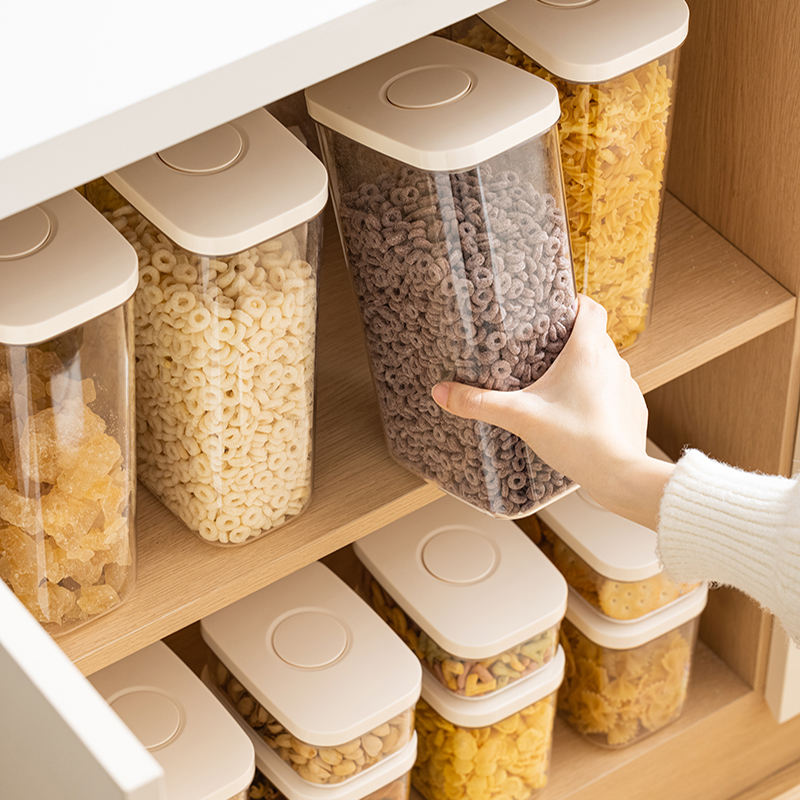
2. Match the seal to how it will be used
Airtight gets used loosely. Ask ten buyers what it means and you will get at least three answers: no leak when you turn it over, no air exchange over a week, or a click you can hear. Only the first is testable without equipment, so it is the one worth agreeing on.
| Lid type | Seal quality | Best use | Trade-off |
|---|---|---|---|
| Push-button | Strong (silicone gasket) | Pantry staples, dry goods | Slightly higher unit cost |
| One-touch | Strong | Everyday kitchen storage | Lid mechanism must be tested |
| Flip-top | Moderate | Grains, cereals, dispensing | Less reliable for liquids |
| Clip / latch | Very strong | Meal prep, travel | Slower to open |
| Screw lid | Very strong | Liquids, sauces | Slow to open and close |
Where lids actually fail in the field is rarely the gasket material. It is the gasket seat. If the channel that holds the silicone is not cleanly moulded, the gasket deforms after a few wash cycles and the seal goes quietly. Look at the seat in your hand, not on the product photo.
For anything that leaves a kitchen, lunch boxes, catering, delivery, use a clip or screw lid. Push-button lids are fine on a pantry shelf, but in a bag carried at an angle they can pop. That shows up most in school and office lunch ranges, and it shows up as returns.
3. Get the compliance evidence right, or do not ship
This is the step buyers skip, and the one that stops a container at customs after it has already been paid for. A container can look identical to a compliant one and still fail on resin grade or pigment.
The standard depends on where it is going:
- United States: FDA food-contact rules, including 21 CFR 177 for the plastic resin.
- European Union: Framework Regulation (EC) 1935/2004, plus Regulation (EU) 10/2011 for plastics.
- Germany: LFGB §30/31, often requested even when the EU framework already applies.
Three things go wrong here, and they go wrong often:
- The report covers a different colour. Migration testing runs on the finished article, and pigments change the result. A report for clear PP does not cover your navy-blue SKU.
- The report is older than the regulation it claims to meet. Rules get revised. A report from five years ago may not satisfy a buyer today.
- The report is for the resin, not the container. Resin certificates are easy to obtain. The finished-product migration report is the one customs and retailers actually ask for.
Ask for the finished-product report with your colour and grade named on it. If the supplier hesitates, that hesitation is the answer.
On BPA: the EU has moved to restrict it in food-contact materials, and most North American retailers now require a BPA-free declaration during onboarding. It is a checkbox, not a selling point. What separates suppliers is whether the paperwork is ready the first time the buyer asks.
4. Understand why the MOQ is what it is
Two routes to a first order, and the gap between them is mostly time and tooling.
| Route | Tooling | Sampling | Typical MOQ |
|---|---|---|---|
| OEM on existing mould | Already built | 5–10 working days | 10–20 pcs per SKU |
| ODM with new design | New mould needed | 3–5 weeks incl. tooling | Confirmed per project |
Low MOQ is not a discount. It exists because the mould already does. On an existing tool a supplier can run your colour, then the next buyer's colour, and purge the barrel between runs. The moment you ask for a new shape, the economics reset: the mould has to be built, it takes weeks, and it needs a first-article inspection before anyone runs a batch.
Two details worth settling in writing: who owns the mould if you pay for it, and whether the quoted unit price excludes tooling. Both are normal questions. A supplier who gets vague about either is telling you something worth hearing.
5. Treat packaging as part of the product
The container is the product. The carton is the reason it arrives intact and the reason it sells. They belong in the same bill of materials.
- Supermarket shelf: printed sleeve or colour box, barcode, and a footprint that holds its shape when stacked six high.
- E-commerce: a carton that survives a drop test, not just one that photographs well.
- Private label: logo by silk print, label or sleeve, with artwork signed off before the bulk run.
A printed sleeve is cheaper than a full colour box at low volume, but it shows dents. A box protects better and costs more. Barcodes and retailer labels are cheap to add and expensive to retrofit, so put them into the artwork before the first run, not after.
6. Compare suppliers on evidence, not price
Price is the last row in the comparison, not the first.
- Factory or trader? A trader is not automatically a problem, but you should know which one you are talking to, because it changes who owns the quality risk. Ask for a live walkthrough of the lines. Stalling on it is information.
- Does an existing mould cover your size? A supplier already running your capacity avoids the tooling cost entirely.
- Can they issue the report for your market? FDA, EU or LFGB, for your exact colour and grade.
- What is the real sampling time? Stock in days, branded in about a week, new tooling in weeks. If someone promises a custom sample in three days, ask which mould they are cutting it from.
- Lead time, and what it includes. A quoted 35 days usually means ex-works after the deposit clears. Ask whether material lead time and packing are inside that number.
- Reorders and after-sales. Who handles a damaged batch, and how quickly can they replace it?
Our own factory runs 30,000–50,000 m² in Guangdong with 101–200 staff, and we will walk you through the moulding and packing lines on video before you place an order. Ask us the six questions above and see how the answers read.
FAQ
What material is best for food storage containers?
PP for most retail ranges: BPA-free, rated to about 100°C, microwave-safe and cheaper than clear alternatives. Choose Tritan only when glass-like clarity is the selling point.
What is a reasonable MOQ for food containers?
On an existing mould, 10 to 20 pieces per SKU is common. New tooling resets the economics and needs a much higher quantity, confirmed per project.
Are BPA-free food containers required by law?
The EU has moved to restrict BPA in food-contact materials, and most North American retailers require a declaration to list a product. Treat it as a baseline.
How do I test whether a container is airtight?
Fill it with water, close the lid, invert it and leave it five minutes. A leak at the gasket means it is not airtight. Repeat three times before approving a sample.
How long does sampling take?
Existing mould, about 5 to 10 working days. A new design with tooling, 3 to 5 weeks.
Where to start
Start with PP on an existing mould. Get the finished-product report that names your colour. Test the lid yourself, water in, lid on, five minutes upside down, before you approve a sample. Those three decisions remove most of the risk from a first order. The rest you can adjust once you have real sales data.
Need a quote for a specific size, colour or certification? Send your specification. A real person reads it and replies, usually within one business day.